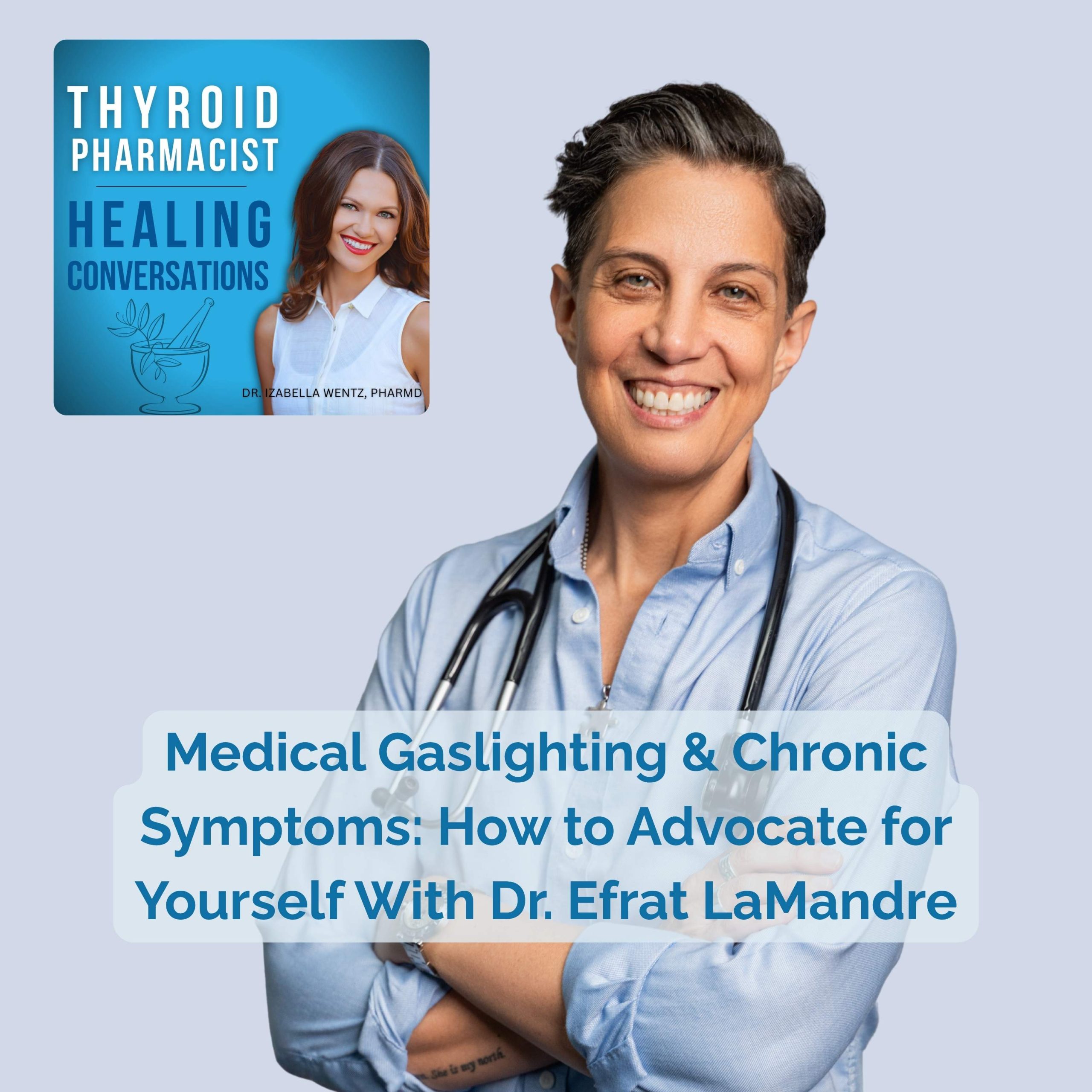
LISTEN TO THE PODCAST – Also available on Spotify and Apple Podcasts
In this episode of Thyroid Pharmacist Healing Conversations, I spoke with Dr. Efrat LaMandre (known as Dr. E) about a topic that I know can bring up a lot of emotion for many of us: medical gaslighting.
When we hear the term “medical gaslighting,” it’s easy to assume that it means a doctor or healthcare provider is intentionally dismissing us or doesn’t care. But as Dr. E explains, medical gaslighting can happen even when there is no malicious intent. In fact, it happens with providers we like and trust. Part of the reason is that healthcare professionals are trained to listen for specific clues that help them arrive at a diagnosis; when testing doesn’t reveal a diagnosis, the conclusion is usually that “nothing” is wrong.
We also talked about the other side of this dynamic: how patients are taught from childhood to defer to medical authority, apologize for taking up a provider’s time, and trust lab results and imaging over their own experience. This can lead us to second-guess ourselves and even gaslight ourselves when we know something isn’t right.
In this episode, we discuss:
- What to do when you’re told “everything looks normal” but you KNOW something isn’t right. Dr. E talks about why a normal test result doesn’t necessarily mean everything is OK – and what to do when it’s time to seek another perspective.
- Whether you may be accidentally gaslighting yourself. It’s easy to dismiss your own symptoms or decide you should just push through. Dr. E shares what happened after she dismissed her own persistent back pain, the life-changing diagnosis that followed, and why your concerns deserve attention.
- Why changing the way you talk to your provider can change the outcome of a visit. Taking a data-based approach – for instance, talking about timelines, patterns, and numbers – will help them get a clearer picture of what’s going on while sending the message that you are knowledgeable and serious about your health.
- Why you don’t need to choose between conventional and functional medicine. What if the problem isn’t a matter of one person being “wrong,” and the other being “right?” The best strategy, according to Dr. E, is to build a healthcare team of different practitioners who offer equally important information, support, and expertise.
- Why you may be apologizing for taking up your doctor’s time. From a young age, most of us are conditioned to be “good patients” and to defer to authority, minimize concerns, and assume the expert knows our body better than we do. Here’s how to advocate for yourself without becoming confrontational or feeling like you have to prove yourself.
- Why you must keep looking for answers. Whether it’s your own health or something you’re noticing in your child, Dr. E’s message is simple: trust yourself. Keep asking questions, keep looking for answers, and keep looking for other types of experts to build a comprehensive healthcare team.
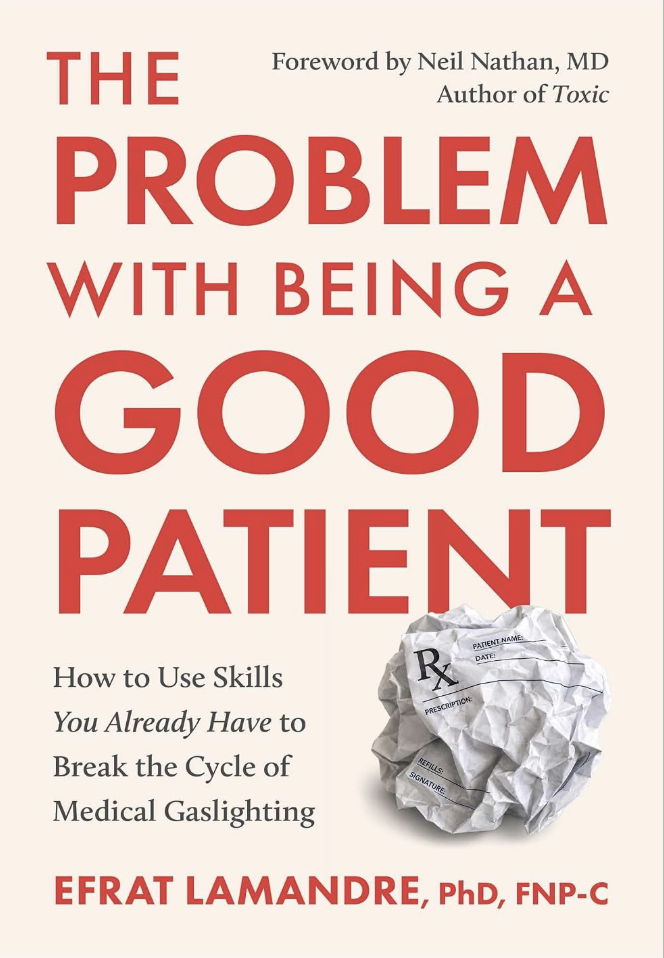
Pre–Order The Problem with Good Patients
The Problem with Good Patients: How to Break the Cycle of Medical Gaslighting is Dr. E’s upcoming book about learning how to advocate for yourself in the exam room and break the cycle of self-gaslighting. It comes out in March 2027, and you can preorder it here.
Connect with Dr. E
- Sign up for Dr. E’s newsletter, The Medical Middle Ground
- Check out Dr. E’s website
- Follow Dr. E on Instagram, Facebook, TikTok, LinkedIn, and YouTube
- Listen to Dr. E’s podcast, Medical Disruptor
- Order Dr. E’s new book, The Problem with Good Patients
- Read Dr. E’s book It’s NOT in Your Head
Tools and Resources Mentioned
- Symptom trackers – Tracking when symptoms occur/what changes them, and noting patterns over time, can help you communicate more specifically with your healthcare provider.
- Health and wellness apps – Tracking things like calories, exercise, menstrual cycles, or other health patterns can help you identify trends and communicate more concrete information to your provider. Consider Natural Cycles for cycle tracking or a wearable like Apollo Neuro to track sleep and more.
- MRI/scans and diagnostic testing – Dr. E emphasized the importance of not automatically dismissing persistent or concerning symptoms, and shared her own experience of wishing she had pursued imaging sooner.
Healthcare services and providers mentioned
- Primary care provider (PCP) – A primary care provider can help with general medical care and initial evaluation, but may not be the right practitioner for every health concern.
- Endocrinologist – A medical specialist who focuses on hormone-related conditions, including thyroid disorders.
- Functional medicine provider – A practitioner who may evaluate health concerns from a broader, root-cause-oriented perspective. Dr. E emphasized that functional medicine and conventional medicine can work together rather than being treated as opposing approaches. See my Patient-Recommended Practitioner Database.
- Nutrition specialist – A nutrition-focused practitioner who can provide dietary guidance as part of a broader healthcare team.
- Functional oncologist – A practitioner Dr. E sought out to complement her conventional oncology care with additional support.
- Oncology nutrition specialist – A nutrition professional specializing in nutritional support for people undergoing cancer care.
- Acupuncturist – An example of another type of practitioner who may be incorporated into a broader, multidisciplinary healthcare team.
Health screenings mentioned
- Colonoscopy – Dr. E recommends that colonoscopy screening start at 45, with earlier screening potentially appropriate depending on individual risk factors.
- Mammogram – Regular mammograms (or breast ultrasounds) should start at age 40, with earlier screening potentially appropriate for those with a family history. Learn more about a functional approach to breast cancer screening in my podcast with Dr. Jenn Simmons: Hormones, Toxins, and Breast Health: Breaking the Myths and Building Solutions.
- Pap smear – A routine screening test for cervical cancer that Dr. E recommends starting earlier than some of the other screenings discussed.
- PSA testing – A prostate-related blood test Dr. E recommends for men over 40 as part of routine blood work.
- DEXA scan – A bone-density screening used to evaluate for osteoporosis, which Dr. E mentioned beginning around age 65 unless earlier screening is warranted.
Articles and Resources
- What Type of Doctor Should You See If You Have Hashimoto’s?
- Common Questions about Lab Tests, Your Doctor, and Your Thyroid
- Top 10 Thyroid Tests and How to Interpret Them
- A Pharmacist’s Review of Medications for Hashimoto’s and Hypothyroidism
- Patient-Recommended Practitioner Database
- 4 Key Steps That Can Help You Diagnose Hashimoto’s and Monitor Your Treatment Progress
Get the Full Episode Transcript
Let’s Connect!
- Follow me on Instagram: @izabellawentzpharmd
- Get my FREE weekly thyroid & gut health newsletter: Sign up here
- Subscribe & Review: If you loved this episode, please leave a review on Apple Podcasts or rate it on Spotify!
Got questions? Drop them in the comments! 🙂
About Our Host
Dr. Izabella Wentz
Dr. Izabella Wentz is a compassionate, innovative, solution-focused integrative pharmacist dedicated to finding the root causes of chronic health conditions. Her passion stems from her own diagnosis of Hashimoto’s thyroiditis in 2009, following a decade of debilitating symptoms.
Dr. Izabella Wentz has written several best-selling books, including the New York Times bestseller Hashimoto’s Thyroiditis: Lifestyle Interventions for Finding and Treating the Root Cause, the protocol-based #1 New York Times bestseller Hashimoto’s Protocol: A 90-Day Plan for Reversing Thyroid Symptoms and Getting Your Life Back, the Wall Street Journal bestseller Hashimoto’s Food Pharmacology: Nutrition Protocols and Healing Recipes to Take Charge of Your Thyroid Health, and Adrenal Transformation Protocol. Her latest book, IBS: Finding and Treating the Root Cause of Irritable Bowel Syndrome, is now out in the world, and available here!
Thyroid Pharmacist Blog
Instagram
Facebook
TikTok
YouTube
Rootcology
About Our Guest
Dr. Efrat LaMandre, known as Dr. E, is a nationally recognized nurse practitioner who calls out a problem most patients recognize instantly but few clinicians are trained to name: medical gaslighting. Her work examines why patients are dismissed when tests are normal and why “you’re fine” so often becomes the end of the conversation. As a practicing NP, Dr. E speaks from inside the system, not outside it. She is also the host of the Medical Disruptor podcast, where she brings clinicians, researchers, and public health leaders into honest conversations about trust, power, and the limits of what medicine currently measures. Dr. E’s talks reframe how we think about symptoms, reassurance, and self-advocacy, giving audiences practical language and insight that changes how patients and providers meet in the exam room.
Website
Instagram
Facebook
TikTok
LinkedIn
YouTube
Medical Disruptor Podcast





Leave a Reply