LISTEN TO THE PODCAST – Also available on Spotify and Apple Podcasts
If you’ve ever been told hormones are “dangerous,” or you’re “too young” (or “too old”) for hormone therapy… you’re not alone. In pharmacy school, many of us watched the narrative swing from “everyone gets HRT” to “never touch hormones because cancer!” That “whiplash” left a lot of women confused, fearful, and frankly, suffering unnecessarily.
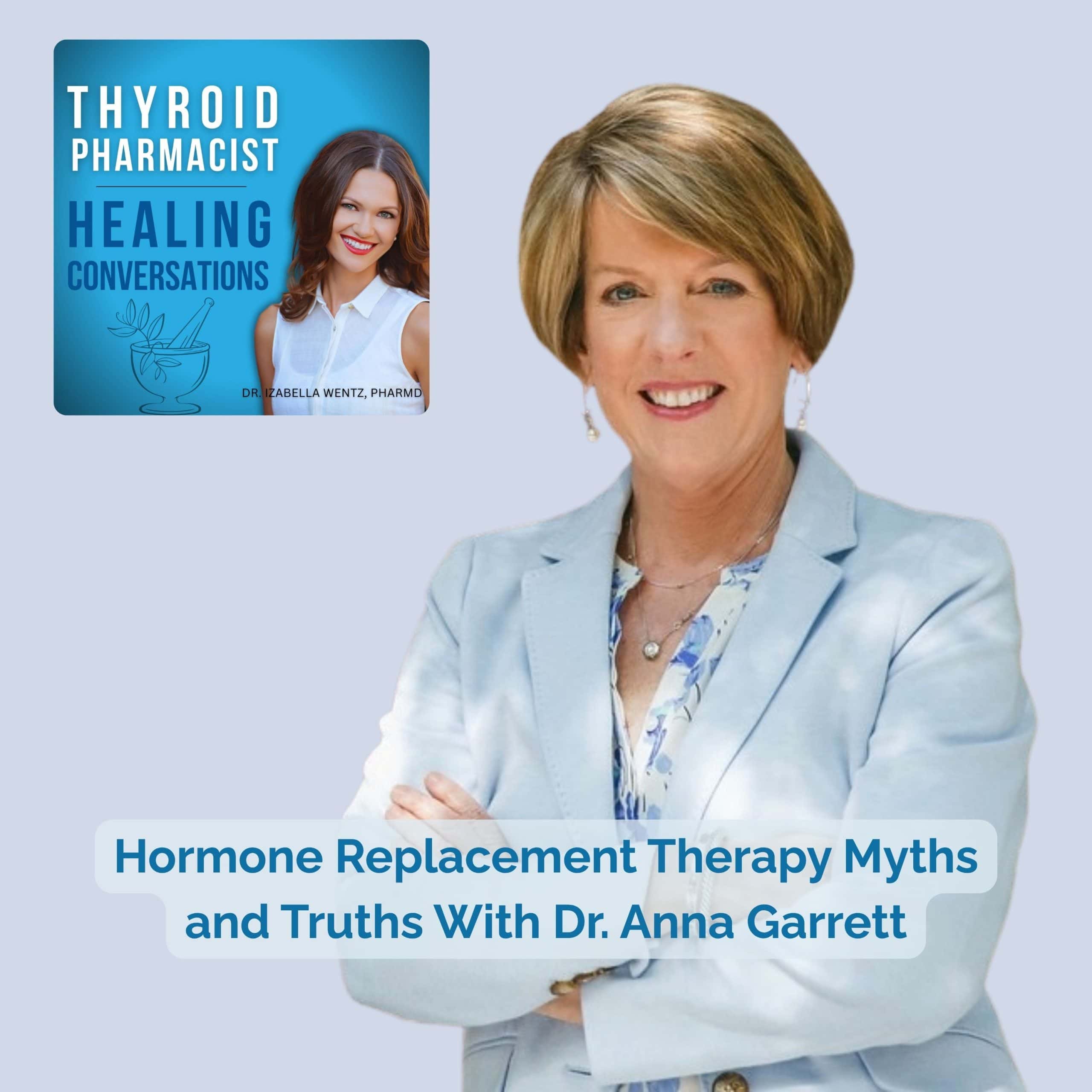
In this episode of the Thyroid Pharmacist Healing Conversations podcast, I interview fellow pharmacist and menopause expert Dr. Anna Garrett about what hormone therapy actually is today (hint: the research looks much different than it did in 2002), what the research really says about estrogen and cancer risk, and how women can make an informed, empowered decision that fits their body, their symptoms, and their goals.
We also get into practical, real-life questions: Why did progesterone help my sleep… until it didn’t? Why do some women do great on estrogen patches, while others struggle? What’s the deal with testosterone for women – and why are we all expected to “measure a pea-sized amount” like it’s a cooking show?
What you’ll learn in this episode:
- Why the “hormones cause cancer” narrative won’t die despite a flawed WHI study. Dr. Garrett explains how the Women’s Health Initiative used older products (like conjugated equine estrogens and synthetic progestins), and why today’s bioidentical options have a very different risk/benefit profile. She also shares the resource that helped her advocate for herself – even with a strong family history of breast cancer.
- Progesterone supplementation can be a smart starting point, even for mid-30s hormone chaos. If you’ve suddenly developed insomnia, anxiety, mood swings, or “crime scene periods,” it may be a sign you’re ovulating less frequently (and losing that calming progesterone effect). We talk about why progesterone alone can be a smart starting point for many women.
- When progesterone stops working for sleep, this may point to a drop in estrogen. Dr. Garrett shares how low estrogen can become a bigger driver of sleep disruption in late perimenopause/menopause, and why combining estrogen and progesterone can be the “lights back on” moment for some women.
- Testosterone isn’t a “male hormone” – and dismissing it can cost women strength and vitality. Dr. Garrett shares why testosterone matters for muscle maintenance, bone health, drive, and overall wellbeing… plus why pellets can be risky if you haven’t dialed in your dose.
- The DUTCH test and hormone pathways: why metabolism matters as much as dosing. Even bioidentical hormones can create unwanted effects. Dr. Garrett walks through tools and nutrients used to support healthier estrogen/testosterone metabolism – and why these tests are best interpreted with a trained practitioner.
- How to decide if hormone therapy is right for you (without needing a medical degree). We talk candidly about “shared decision-making,” quality of life, clotting risk considerations, transdermal estradiol versus oral estrogen, micronized progesterone, and experimenting with HRT to see if it’s right for you.
Perimenopause is a hot topic these days, for myself and many women I know. If you’re in the same boat, I highly recommend picking up a copy of Dr. Garrett’s book, Perimenopause: The Savvy Sister’s Guide to Hormone Harmony. Women are inundated with information on how to have healthy, happy pregnancies, but we get left out on the opposite end of the reproductive spectrum. That stops now! In this entertaining, information-packed book, Dr. Garrett shares everything you need to know about your body and how to care for it to create hormone harmony.
Guest Resources / Connect with Dr. Anna Garrett
- Learn more at Dr. Anna Garrett’s Website
- Follow Dr. Anna on Instagram, Facebook, and YouTube
- Join her private Facebook group: Hormone Harmony Club
- Perimenopause: The Savvy Sister’s Guide to Hormone Harmony by Dr. Anna Garrett
Supplements We Discussed
- Magnesium – Supports relaxation, sleep quality, and hundreds of enzyme-dependent processes in the body. Consider Rootcology Magnesium Citrate Powder.
- DIM (Diindolylmethane) – Often used to support estrogen metabolism pathways (best used with guidance, especially if estrogen is low).
- Quercetin – A flavonoid that may support histamine balance and inflammatory signaling; sometimes used when DIM isn’t appropriate.
- Rosemary extract – Used in some functional protocols to support detoxification and oxidative balance.
- Calcium D-glucarate – Supports healthy estrogen clearance and helps reduce re-circulation of estrogen metabolites in the gut.
- Trimethylglycine (TMG/betaine) – Supports methylation pathways that play a role in hormone metabolism. (If you don’t have a Fullscript account, you can sign up with my credentials here.)
- Stinging nettle – Often used to support androgen balance and help modulate conversion to DHT. (If you don’t have a Fullscript account, you can sign up with my credentials here.)
- Pygeum – Commonly used in DHT-modulating protocols to support hair and skin effects tied to androgen metabolism.
- DAO enzyme (diamine oxidase) – A supplemental enzyme that can help break down dietary histamine, especially for those with histamine intolerance symptoms.
Other Tools and Resources
- DUTCH Test (Dried Urine Test for Comprehensive Hormones) – A comprehensive hormone + metabolite assessment tool used by many functional practitioners.
- GI-MAP – Stool testing can help identify gut patterns that may contribute to estrogen recirculation and histamine issues (especially when constipation is part of the picture). Order the GI-MAP test here.
- Coronary calcium scan / carotid Doppler / advanced lipid testing – Cardiovascular risk tools sometimes used when evaluating later initiation of hormone therapy.
- Vaginal estrogen for recurrent UTIs and dryness – A potentially life-changing tool for genitourinary symptoms (and a quality-of-life issue that’s wildly under-addressed).
- Sleep trackers – Wearable trackers like the Oura Ring can help identify low deep sleep, frequent wakeups, and trends that need intervention.
- Follow specialists in hormone therapy for evidence-based education and shared decision-making conversations (as recommended by Dr. Garrett): Dr. Lindsey Berkson, Dr. Mary Claire Haver, Dr. Corinne Menn, Dr. Kelly Casperson
Books and Articles About Menopause, Hormones, and Women’s Health
- Estrogen Matters: Why Taking Hormones in Menopause Can Improve Women’s Well-Being and Lengthen Their Lives — Without Raising the Risk of Breast Cancer by Avrum Bluming, MD & Carol Tavris, PhD
- The Menopause Society (NAMS) – Hormone Therapy overview
- NAMS 2022 Hormone Therapy Position Statement (PubMed)
- Dr. Lisa Mosconi, PhD – Researcher who studies how hormones affect the female brain. Check out her book, The Menopause Brain: New Science Empowers Women to Navigate the Pivotal Transition with Knowledge and Confidence.
- Estrogen Dominance as a Trigger for Hashimoto’s
- Did Your Thyroid Condition Start or Worsen During Perimenopause?
Get the Full Episode Transcript
Let’s Connect!
- Follow me on Instagram: @izabellawentzpharmd
- Get my FREE weekly thyroid & gut health newsletter: Sign up here
- Subscribe & Review: If you loved this episode, please leave a review on Apple Podcasts or rate it on Spotify!
Got questions? Drop them in the comments! 🙂
About Our Host
Dr. Izabella Wentz
Dr. Izabella Wentz is a compassionate, innovative, solution-focused integrative pharmacist dedicated to finding the root causes of chronic health conditions. Her passion stems from her own diagnosis of Hashimoto’s thyroiditis in 2009, following a decade of debilitating symptoms.
Dr. Izabella Wentz has written several best-selling books, including the New York Times bestseller Hashimoto’s Thyroiditis: Lifestyle Interventions for Finding and Treating the Root Cause, the protocol-based #1 New York Times bestseller Hashimoto’s Protocol: A 90-Day Plan for Reversing Thyroid Symptoms and Getting Your Life Back, the Wall Street Journal bestseller Hashimoto’s Food Pharmacology: Nutrition Protocols and Healing Recipes to Take Charge of Your Thyroid Health, and Adrenal Transformation Protocol. Her latest book, IBS: Finding and Treating the Root Cause of Irritable Bowel Syndrome, is now out in the world!
Thyroid Pharmacist Blog
Instagram
Facebook
TikTok
Youtube
Rootcology
About Our Guest
Dr. Anna Garrett has been a clinical pharmacist for over 30 years and has worked in a variety of practice settings. While traveling her career path, she discovered that working with women in midlife is her true passion. Dr. Garrett uses a functional approach in her practice, which includes hormone balancing, weight loss, gut health, personalized wellness plans, and health coaching. Her programs are all designed to help women in midlife stay their healthiest and feel amazing in their bodies so they can keep rocking their mojo through menopause and beyond. She is also passionate about teaching women how to advocate for themselves in the healthcare system. Dr. Garrett is a graduate of the UNC School of Pharmacy, a Certified Intrinsic Coach, a BARE Master Certified Coach, and is certified in functional medicine through the School of Applied Functional Medicine.
In 2019, she published her first book, Perimenopause: The Savvy Sisters Guide to Hormone Harmony. She lives in Asheville, NC, with her best-dog-ever, Ellie.




Leave a Reply